
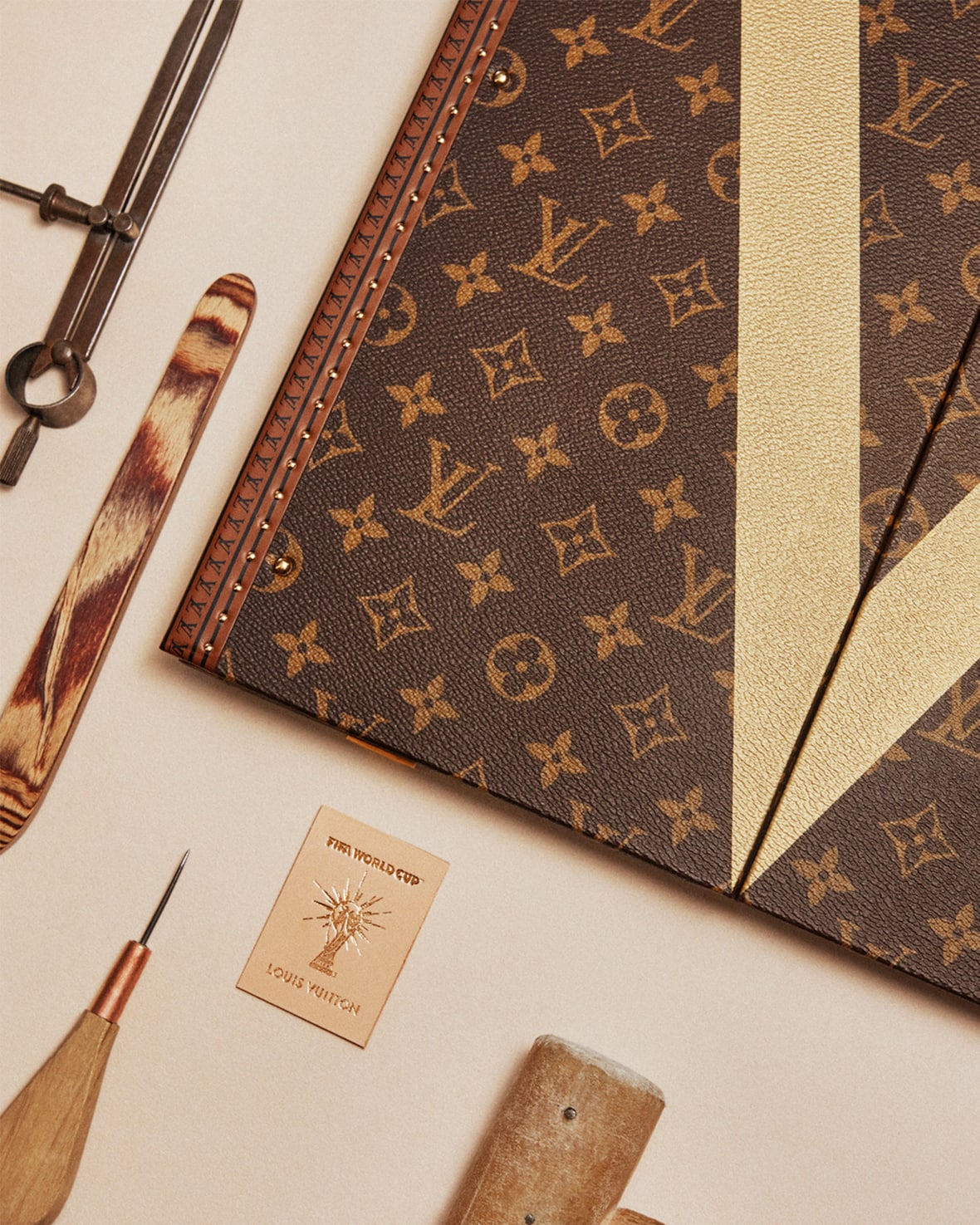
Louis Vuitton has now built five trunks for a trophy it doesn’t play for. Since 2010, every World Cup™ final has arrived at the pitch with its trophy inside a case made at the maison’s historic workshop in Asnières-sur-Seine, outside Paris — the same address where the house has hand-assembled travel trunks since the nineteenth century. This year’s version is wrapped in monogram canvas, with a gold “V” for Victory painted by hand across the front, gold-plated brass corners, and clasps drawn from a design dating back to the 1860s. Louis Vuitton filed the process shots for this campaign under a name that gives away more than it means to: Savoir-Faire Visuals.
A real heritage, just applied somewhere else
That’s not a small claim to make. Before becoming synonymous with luxury handbags, the house was born in the nineteenth century making travel trunks for royalty and explorers — pieces built to protect valuable belongings on journeys that sound almost impossible today: ships, trains, entire expeditions. The craft behind that is genuine. What’s worth sitting with is what happens when the same craft gets pointed at a context with no journey in it at all. This trunk isn’t protecting anything across an ocean. It exists to be carried across a pitch, on camera, for under a minute, before the trophy is lifted back out of it. The hands that built it would have built the same trunk in 1900. The purpose they’re serving now is not the same one.


The question is what happens when that heritage gets reapplied to a context that has nothing to do with travel, expeditions, or royalty — and everything to do with sports sponsorship. The World Cup™ trunk isn’t protecting anyone on a journey; it exists to appear on TV for forty seconds before the trophy is handed over. Is it real craftsmanship, hand-assembled at the Asnières workshop? Yes. But it’s also, without any middle ground, an advertising piece engineered to generate exactly the kind of coverage you’re reading right now. Both things are true at once, and that’s precisely what the celebratory coverage avoids saying.
What’s behind the gold V
The partnership between Louis Vuitton and FIFA is now more than fifteen years old — it started in 2010 and reaches its fifth consecutive edition in 2026. But this edition’s novelty isn’t just aesthetic. LV has stopped being just the house that designs the trunk and has also become an official licensee of the World Cup™ brand, meaning it can now sell an entire collection inspired by the tournament.
The financial context helps explain why: FIFA projects roughly $2.8 billion in sponsorship revenue for the 2026 edition alone. Within that universe, LVMH — Louis Vuitton’s parent company — has been pouring money into sports as a showcase, from Formula 1 to the Olympics. In that picture, the trunk isn’t the product. It’s the business card. The most coveted branding opportunity in sports sponsorship, according to industry analysts, isn’t even the pitch-side ad — it’s the exact moment the trophy walks onto the field in front of the largest television audience on the planet. The trunk is the most valuable free visual argument there is.


Who actually gets close to this trunk
And here lies the simplest irony of all: none of this is accessible to the person watching the match. The average fan will never touch this trunk, will never buy the collection inspired by it, and probably didn’t even know, until this piece, how much the deal behind it is worth. The trunk parades in front of billions of people, but in practice belongs to an audience of dozens. It carries the trophy of the world’s most popular sport — a sport historically tied to the working class — dressed in the exact symbols of everything that audience largely cannot afford.
So, craft or theater?
Both, at the same time — and maybe that’s the most honest answer. The trunk is genuinely well made; the workshop, the handmade process, the trunk-making heritage, none of that is fake. But pretending it’s there purely for tradition, and not for a brand return calculated in the billions, is naive. The Louis Vuitton trunk isn’t a charming exception within football. It’s the most elegant proof that today, the world’s most popular sport is also, quietly, one of the most expensive showcases in the luxury market.

